Published on Jan. 6, 2026
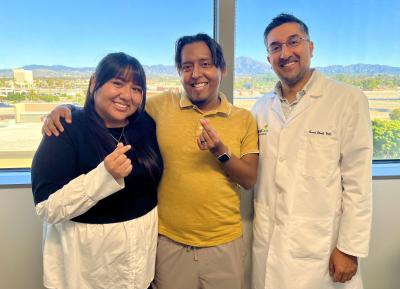
At 31, Leonardo Popoca recently gained control of his lupus—reducing his medications from many downs to just one. He was working his job at a local elementary school, spending time with his wife, Brittany, celebrating his faith, and enjoying his hobbies which range from playing tabletop games to making electronic music through modular synthesizers.
But on a Sunday in October, while doing chores around the house, Leonardo felt extreme pressure in his chest. His heart started racing, and his jaw locked up.
“It felt like a dam opened up and water burst through my chest really fast,” said Leonardo. “Then it slowed down, and it was painful. My first thought was that I must be experiencing a heart attack. I knew I had to call my wife immediately.”
Leonardo called Brittany, who was volunteering at church, and explained his strange feelings, warning her that he was going to call 911. While on the phone with the 911 dispatcher, he recalls just repeating his address. The dispatcher reminded him to grab any medication he might need. He grabbed his lupus medication and waited outside, lying down.
A Missed Diagnosis at the First Hospital
Brittany and the EMT team arrived at the same time. The EMTs did an EKG on Leonardo, but they didn’t find anything unusual, so they loaded him into the ambulance and took him to the nearest hospital. Brittany tried to persuade the EMTs not to take him to the closest hospital, as they had previously experienced unsatisfactory treatment there for Leonardo’s Lupus. EMS transport protocols, however, required them to take him to the closest location.
“When we arrived, they took Leonardo into the ER. They did a blood test and took some vitals. They told us everything looked normal,” said Brittany. “But by this time, Leonardo was feeling back pain and vomiting a ton. To help with the discomfort and nausea, the provider told us they would provide medication, but it wasn’t given right away. I kept calling and going to the nurse station to ask when the medication was going to be administered. It wasn’t until I asked the nurse if we could have the discharge papers along with pain and nausea meds, so I can take him to another hospital.”
They ended up giving Leonardo a nausea pill and the pain medication through the saline drip to help with dehydration and discomfort, then he fell asleep. Brittany was worried about him and wanted to transfer him to another hospital, so they could get a second opinion, but at this point, Leonardo was so tired he could barely keep his eyes open.
“The doctors at the smaller hospital said I could go home, so I told Brittany, ‘It’s okay, let’s try to see what it’s like at home, and then we can decide what to do next," said Leonardo.
Escalating Symptoms and a Race to a Larger Hospital
Once home, Leonardo rested, but by Monday evening, he started experiencing more symptoms. He couldn’t keep liquids down and he started to experience chest pains again.
“It was like two oceans crashing and meeting in the middle of my chest,” said Leonardo. “And this time, Brittany wasn’t having it. She wanted to ensure I went to a different and larger hospital, so she put me in the car and drove me herself. We weren’t going to wait for an ambulance and risk going to the first hospital. She wasn’t taking no for an answer.”
When they got there, like any ER at larger hospitals, there was a long waiting line. Brittany pushed her way to the front, let everyone know he had chest pain, and demanded he be seen right away.
“Her tenacity helped save my life,” says Leonardo.
A Rare Aortic Emergency Revealed by CT Scan
At the second hospital, they started doing an EKG at the ER front desk and taking Leonardo's vitals. Leonardo got a chest X-ray in the triage area and eventually got a room. By midnight, they did a CT scan, and the initial image came back unclear.
The team asked if Leonardo was okay with taking a second image; they were worried about damaging his kidneys due to his lupus. At this point, Leonardo wanted answers and put his faith in a higher power at the forefront of his decision-making and agreed to a second test. The test revealed something that nobody was prepared for—not even the ER team.
Leonardo had an acute type A aortic dissection, with an associated 6.5cm ascending aortic aneurysm. The team told Leonardo that normally, an acute type A aortic dissection requires immediate emergency surgery. Leonardo had been living with symptoms for two days.
A type A aortic dissection is a tear in the largest blood vessel in the body. In many patients, it is immediately fatal.
“The team at the second hospital told me they were surprised I was still upright,” says Leonardo. “They also said they didn’t have a surgical team there, so they were going to make some calls to get me to a place with a high enough level of care. That’s when they called Dr. Asad Shah at Saddleback Medical Center. Here we go again—hospital number three.”
Transferred for Emergency Aortic Surgery
Leonardo was transported immediately over to the MemorialCare Heart & Vascular Institute at Saddleback Medical Center, where cardiothoracic surgeon, Dr. Asad Shah was the physician on Leonardo’s case.
Saddleback Medical Center is unique in that it has a Comprehensive Aortic Program dedicated to the early detection, monitoring, and treatment of various aortic diseases using evidence-based treatments. The team provides rapid and accurate diagnosis and treatment for patients with acute aortic syndrome, which is often life-threatening and includes aortic dissection, aortic ulcer, intramural hematoma, and unstable thoracic aortic aneurysm. The program is a regional referral center for aortic surgery, particularly complex and emergency surgery.
“When Leonardo came to us, he was experiencing the effects of a Type A aortic dissection,” says Asad Shah, M.D., medical director, Cardiac Surgery, Saddleback Medical Center. “Type A dissection is more dangerous than Type B dissection because it's closer to the heart and often requires immediate surgery to prevent rupture or other complications. In Leonardo’s case, we knew we needed to do surgery immediately.”
Inside the OR: A Complex Valve-Sparing Repair
As Leonardo was wheeled up to the operating room, his fun-loving personality came out.
“I know I had a lot going on, but it was like I was in a TV show,” he said. “I just saw the operating room doors swing open, and it was like the surgery team came out in slow motion. One of the nurses squeezed my foot and smiled at me. Another doctor grabbed my shoulder. They made me feel totally reassured.”
The team talked to Leonardo about potentially needing aortic valve surgery as well, as his valve was leaking severely due to the dissection. Leonardo was willing to accept a mechanical valve, and that he would most likely have to be on life-long blood thinners.
“I remember them talking to me about different models or series of valves, and then I just remember saying, ‘You guys seem like you can get this done,’ and I passed out.”
Surgery took place on Tuesday morning and lasted around four hours. He had to be on a heart-lung bypass pump that artificially kept his oxygen and blood pumping through his body while they replaced his dissected aorta. His body had to be cooled down, and his blood flow was temporarily stopped during the complex aortic surgery. His aorta was safely replaced with a prosthetic graft that will last his lifetime. Dr. Shah and the cardiac surgical team also ended up being able to repair the aortic valve with a valve-sparing procedure rather than using a mechanical valve. Leonardo had the most common heart birth defect—a bicuspid aortic valve—that was the cause of his aortic aneurysm and dissection.
Recovery, Gratitude, and a New Outlook on Life
After surgery, Leonardo was in the intensive care unit for three days and recovered on the cardiac floor for about a day before going home. Leonardo also learned that his lupus was a blessing in disguise.
“The scar tissue from the lupus-related pericarditis is what actually held the ruptured aneurysm in place, despite the weakening of the aorta wall,” said Dr. Shah. “Leonardo is a very lucky man.”
Leonardo is now home and recovering. He still sees the cardiac surgery team at Saddleback Medical Center for follow-up care to check how his sternum is healing and has regular follow-ups with his cardiologist.
“The Dual language program at the elementary school sent me a video of them singing the song ‘Sana Sana Colita de Rana’, A song about healing. I knew I had to go visit them during Halloween, and it was so uplifting,” said Leonardo. “I got to see their costumes, and I was just overcome with gratitude for my life. I’m just so grateful for my wife and doctors who saved the life of an ordinary man.”
Leonardo is saddened that he will have to take blood pressure medications along with his one lupus medication. Living with two chronic conditions will be tough, but overall, Leonardo is excited to get back to work, exercising, and spending time with his friends and family.
A Genetic Link and Family Impact
“I found out later that my bicuspid valve issue is most likely genetic, which could impact my brothers,” says Leonardo. “Looking back, I did have small signs that something wasn’t right, but I dismissed them. When I explained my symptoms to my brother, he said he had felt something similar.”
Leonardo’s brothers are now all being tested for the same bicuspid aorta diagnosis he had.
Faith, Family, and the Gift of a Second Chance
“People we have encountered, the doctors and nurses, say that it’s a miracle that Leonardo survived,” said Brittany. “For me, I already knew it was the Lord’s doing, along with the help of the prayers that were said by our family, friends, and the church community. I thank God that he placed this specific surgical team for Leonardo when he needed them. His sickness in the past, though it was a difficult time, was a blessing in disguise. Granted, it was a strange plan looking through my eyes, but to the Lord, it was already planned. I am so grateful that Leonardo is still here, and I thank the surgical team, nurses, family, friends, and our Church for being there for us. Above all, I thank God.” said Brittany.